




Just found some of my old journals from Harvard. I found a quote of a kid in my choir who was drunk: “I’ve had so much vodka that I don’t mind that this is London Dry instead of Bombay Sapphire.”
Yep. It’s like pretentiousness boot camp.
Just found some of my old journals from Harvard. I found a quote of a kid in my choir who was drunk: “I’ve had so much vodka that I don’t mind that this is London Dry instead of Bombay Sapphire.”
Yep. It’s like pretentiousness boot camp.
I used to see a physical therapist twice a week in midtown Manhattan. This was years ago, when I was living in Brooklyn, and way before Brooklyn was cool.
Anyways, right next door to my physical therapist’s office was a fancy salon, named after the founder, a woman d’un certain age. The salon sold high-dollar youth creams and beauty potions.
One day, I shared the elevator with the founder of this beauty line. She must have been at least 50, but still had incredibly smooth, flawless skin. “You know, you really do have amazing skin,” I said. “What’s your secret?”
She smiled. “Genetics.”
And so she’d made a fortune selling creams and lotions, because her skin was her calling card — even though those products had nothing to do with her beauty.
This brings me back to something I’ve noticed many times: We always take advice from the wrong people.
If we want to lose weight, we’ll ask our skinny friend with the fast metabolism rather than our normal-size friend who actually lost weight.
We also prefer bad advice from charming people over good advice from boring people. We prefer to believe the beautiful person holding court in the center of the room, and ignore the nerd in the back, who’s adding up the sums accurately and ruffling feathers when he says they’re wrong. This is because we trust advice based on who we want to be, rather than what we want to do.
This leads to all sorts of misperceptions in the world about how people actually got to where they are in life:
Tell me Ms. Jones, how did you become such a successful saleswoman and get those cold call sales?
Answer: “Self-confidence and a great work ethic”
Real Answer: “Model-perfect good looks”
Mr. Smith, you’ve become so very successful at business. To what do you attribute your success?
Answer: “Creativity and thinking outside the box”
Real Answer: “Family money”
People watching these interviews say to themselves, “That’s right! If I want to be a success like her, I just need to be more self-confident!” Whereas they might get farther with major plastic surgery.**
So basically, as I said, most people have a natural instinct to trust advice based on who we want to be, rather than what we want to do. But, once we know that might be a pitfall, we can be aware of it, and try to compensate for it.
Also, this tendency to follow “winners” — even if they win for the wrong reasons — robs us of great wisdom, because failures often have excellent advice. People who fail multiple times in an undertaking know what doesn’t work – so you don’t have to try it yourself. And, when they do eventually make it past their roadblocks, they can actually tell you what they did, rather than bragging about what they thought they were doing while the universe took care of the rest. Failures often understand the process to success better than someone who’s naturally gifted. But still, we gravitate to the prodigy as the master, and ignore the person in the back, who struggled to learn everything they mastered…and so knows how to teach.
———————————————
** And no, I am not advising you to get plastic surgery. You have a great nose, don’t ever let anyone else tell you differently.
There’s a flamenco dancer living in Madrid named Sofia Echegaray. I wonder if she secretly wants to be a singer-songwriter living in Austin, Texas.
Beauties want to be known as smart.
Brains want to be known as pretty.
Heiresses want to be known as accomplished.
Hard workers want to be known as fun and cool.
We all want something.
I hate extraneous packaging. Case in point: the toothpaste box:


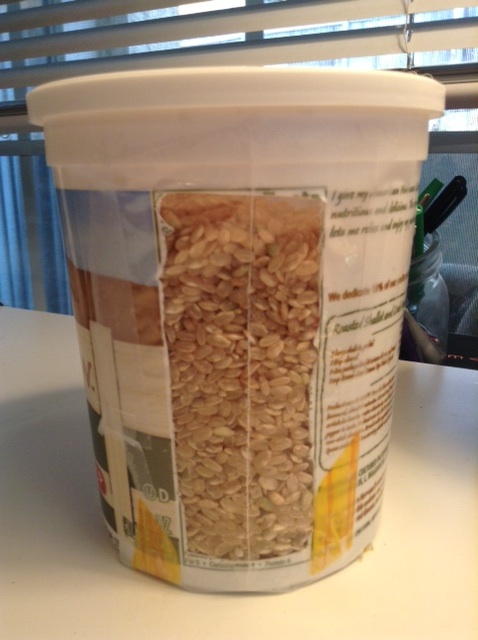
I just made my old yogurt containers useful by turning them into dry-goods canisters with a peekaboo window. I cut out a small vertical panel by following the lines of the nutrition info box, and taped re-used plastic from an empty bread bag.
This makes me happy.
During my period of extended convalescence, I’ve had a lot of free time in my apartment, stuck inside. So, I started doing things I never used to do before, like reading glossy magazines. Waste of time and/or money? What else was I going to do all day?
Here’s what I’ve learned:
1. A Flat Stomach makes you Pure.
In the olden days, our culture was obsessed with a woman’s virginity. Nowadays, we’ve decided it’s ok to have sex, as long as you look like you are a virgin — i.e., 12. So, our strange compromise has led us to fetishize 25-year-old women with the body fat of preadolescents.
If at any point of your life, your curves do not make you appear 12, then you must be a witch a prostitute “fat.”
2. A Well-Appointed Closet is the new Porn.
Did you know that if your bedroom closet is perfectly arranged and color-coded. you have succeeded at the game of life? There will be much Wailing and Gnashing of Teeth, as other women Rue Your Victory.
Now sit down, perfect-closet-having-person, and have a nice romantic dinner for two, just You. And Your Closet.
3. Inherited wealth is an accomplishment.
An “accomplishment” is when you do something remarkable with what you are given — such as becoming rich after being born into poverty. Or, for that matter, becoming compassionate after being born into privilege. But starting a frivolous clothing line at Bendel’s because you’re an heiress with nothing better to do is not that remarkable.
4. A nice home bought with lots and lots of money is also an accomplishment.
Look, if I had 5 million dollars to spend on a Paris apartment, I’m sure my place would look nice, too.
5. The best way to live a simple, uncluttered life is to buy lots of new stuff.
“But honey, it’s a zen coffee table!”
6. The second best way to live a simple, uncluttered life is to buy lots of magazines advocating simplicity.
Piles of old magazines will give your Buddhist-retreat vibe that perfect touch.
7. Have a major life decision on your horizon? A short quiz written by strangers may be your salvation.
Yes, it’s true that some people spend years of searching to figure out their ideal mate, career choice, and management style, but maybe that’s because they didn’t take the quiz in the middle of O Magazine.
Back when I bought albums, rather than downloads, I usually bought an album because there was one song I absolutely had to have…and I was hoping that the rest of the album would be worth it. When I’d get the album home, I’d play the hit song, and then I would start the process of exploring the rest of the songs, hoping that they’d be worth my time.
That first song, the one that hooked me onto the album, I’d play that one about a zillion times. But as the weeks would pass, songs that I hadn’t noticed that much – the ones that weren’t as flashy — often ended up grabbing my attention. Sometimes, with repeated listens, the “hit” would get old, while that shy one on track 3 revealed more and more layers. And those would be the ones that stayed with me, week after week, month after month, year after year.
In praise of the Sleeper Hit!:
Album: The Miseducation of Lauryn Hill / Lauryn Hill
Song I bought the record for: Doo-Wop (That Thing)
Songs I fell in absolute love with: Ex-Factor and I Used to Love Him
Best Line: “Tell me who I have to be / to get some reciprocity”
Album: New Non-Fiction / Susan Werner
Song I bought the record for (and still love): May I Suggest
Songs I fell in absolute love with: Pretty much the whole album, especially “Stationary,” “Misery and Happiness,” and “Barbed Wire Boys”
Best Line: “Tough as the busted thumbnails / on their weathered hands / they worked the gold plate / off their wedding bands”
Album: Hits / Joni Mitchell
Songs I bought the record for: Big Yellow Taxi, The Circle Game
Songs I fell in absolute love with: Carey and California
Best Line: “So I bought me a ticket, I caught a plane to Spain / Went to a party down a red dirt road / there were lots of pretty people there / readin Rolling Stone readin Vogue”
Album: Mama’s Gun / Erykah Badu
Songs I bought the record for (and still love): Bag Lady
Songs I fell in absolute love with: Penitentiary Philosophy, Didn’t Cha Know?, Time’s a Wastin
Best Line: “Bag Lady, you gon’ miss your bus / you can’t hurry up, ’cause you got too much stuff”
As some of you know, I am a devotee of a spiritual teacher named Mata Amritanandamayi, or “Amma,” sometimes known as “The Hugging Saint” in the West.
One of the reasons I love her is that I am, quite simply, crazy. I have a whole lot of thoughts and ideas about myself and the world that are completely ill-founded. What’s worse – I’m smart. And smart people’s Achilles’ heel – or more accurately, Achilles’ Hell – is that we have a tendency to fall in love with convincing arguments, and cling to them like dogs gnawing on used-up bones. Once a ‘smart’ person gets a logical, well-constructed argument in their head, they’ll often follow it slavishly, long past the point of accuracy, common sense, or even personal happiness.
Imagine that your mind is like a party. When you’re smart in a certain kind of way, all those seemingly-rational (but deeply flawed) arguments sparkle like those mean-girl hotties. They outshine good ol’ Common Sense, who would totally love to talk to you, if you would only give her a minute of your time. But she’s over there, by the back, almost crowded out, poor thing, and you only learn what a good conversationalist she is once all the shiny girls have already left.
We “smart people” love the comforts of our if-then statements. We feel they provide stability, and even structure. But often, they are so rigid and so paralyzing that, instead of providing the positive structure of a scaffolding — that is to say, a foundation for improvisation and growth — they provide the negative structure of…a prison. So-called logical thinking often becomes so draconian and rigid that it only provides limitation, stagnation, and fear.
For example, when I was a teenager at boarding school, my mother — a very smart person — decided to take a one-year teaching appointment in a far-away state. At the beginning of the school year, she found an unfurnished apartment, and said, “You know, moving my furniture down will cost a lot of money. I’ll move it down later. And you know what? I slept on the carpet last night, and it really wasn’t that uncomfortable! I don’t mind it for a week or two, especially with some blankets underneath me for cushioning. I’ll deal with the furniture soon, once I get settled in my new department.”
A week or two became three months, and when my Christmas vacation came, I had to ask my mother to buy me a mattress. Spending Christmas in an empty apartment, sleeping on a mattress on the floor, I begged my mother to move the furniture down at last.
She said, “My one-year appointment might not be renewed, and moving is so very expensive. The year’s half-way over. I’ll wait until spring, and then if my contract is renewed, I’ll move it down.”
Summer came, and her contract was renewed, but again she rationalized, and I spent a summer sleeping on the floor in an empty apartment. All told, she would spend three years in that state of suspended animation, all the while promising to move the furniture down “soon.”
My mother was the most intellectual of all my friends’ parents. While her peers had more ordinary pursuits, my mother read voraciously, and talked at length about art, literature, and culture. But the thing is, if you had asked any of my friends’ ordinary parents, “Do you think it is a good idea for you and your daughter to sleep on mattresses on the floor in an empty apartment for the next three years?” they would have said something like: “Don’t be ridiculous. As long as I am not completely destitute, I will make sure that my child and I have a decent home.”
By the end of my mother’s strange time in limbo, her refusal to provide me with that decent home had pushed me far away. She had also, by the by, ended up spending at least as much on storage fees as she would have on moving expenses. But her fear had latched onto a convoluted “logic,” and trapped her in a bad decision. The kind of bad decision that wouldn’t even have occurred to someone who wasn’t, you know. Smart.
In this way, smart people become prisoners of their own minds, and their strengths become their weaknesses.
 Radio Sof