




…did not send man to the moon.
…did not create the internet.
…did not cure polio
Nope. That was NASA (government program), DARPA (government military program), and Jonas Salk (funded by a charitable foundation).
…did not send man to the moon.
…did not create the internet.
…did not cure polio
Nope. That was NASA (government program), DARPA (government military program), and Jonas Salk (funded by a charitable foundation).
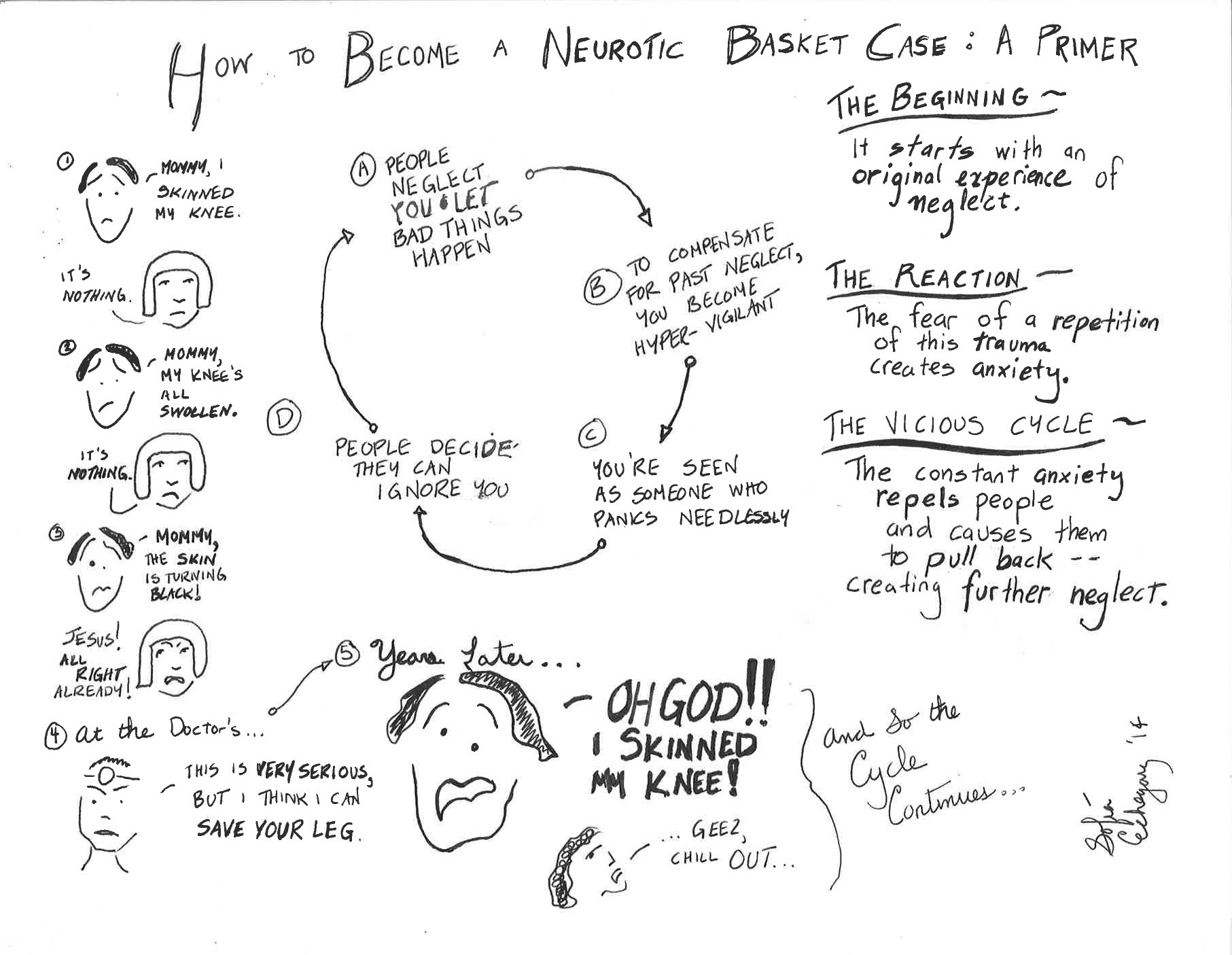
How to Be Neurotic
A headline caught my attention on wbur.org today:
People Flee Frigid Cold, Fill Homeless Shelters
Homeless shelters in Boston are reporting that they’re filled to capacity as people try to escape the single-digit temperatures.
It’s remarkable what a difference language makes. WBUR is making an effort to refer to the homeless as “people,” rather than just “the homeless.”
Once we call them “people,” it removes the distancing that allows us to feel removed from the situation. When we think of them as people without a place to stay, it shows more clearly the gravity of the situation, and makes us feel an urgency about their plight.
Try this thought experiment: compare the first group of words to the second. Do you feel more empathy for the second group?
“slaves” vs. persons who have been kidnapped and forced to work as prisoners
“battered women” vs. women married to abusive husbands
“convicts” vs. men in prison
“the poor” vs. people with low income
“the disabled” vs. people with disabilities
“minors” vs. young people
“the elderly” vs. people over 65
Obviously, some of these expressions would be too cumbersome or inexact to use in regular conversation. Still, it is good to notice. When do our words allow us to forget the humanity of others? And when do they allow us to remember?
Every once in a while, I find an essay that really stays with me. Here are a few gems I’ve found over the years.
In You’re a Good Man, Dr. Smurf — one of my favorite essays of all time — Martha Beck describes her intimidation as a Harvard student, surrounded by colleagues who appear brilliant and omniscient. Until, one day, in a very funny way, she realizes that everyone around her is totally and utterly bullshitting.
Rebecca Solnit’s essay Men Explain Things to Me is the essay that launched a thousand blog entries. She begins with a story of the time an older man patronizingly describes a book to her — her own book, as it happens. This essay inspired the term “mansplaining.”
In Does Gender Matter? Dr. Ben Barres describes the culture of the sciences from his unique vantage point as a transgender scientist: Shortly after I changed sex, a faculty member was heard to say “Ben Barres gave a great seminar today, but then his work is much better than his sister’s.”
If you like a long, richly-detailed essay, try The Marriage Cure by Katherine Boo. It explores the theme of poverty, by following several women trying to make the best out of terrible situations. A moving essay that provides no easy answers, but plenty of questions.
And finally, a short essay called “Those Aren’t Fighting Words, Dear” — published in the Modern Love section of the New York Times of all places! — had a simple but profound effect on me. It’s about a middle-aged man who tries to solve his midlife crisis by breaking up his marriage, and how his wife’s verbal jujitsu enables them to get through his rough patch and stay together.
Now go ye forth, and Read!
(cross-posted on Applied Grace)

One of the most important principles of problem-solving is that changing the definition of the problem can help you come up with a solution. To illustrate this, I’m going to use a children’s story I read in grade school:
A hero goes to steal a valuable treasure from a king. The king is protective of his treasure, and keeps adding more and more locks to the door of his vault. But the hero is able to open the door and make a clean getaway. How? He takes the door off its hinges.
In other words, the hero re-frames the problem, reducing the problem down to its most basic components. He changes the problem from:
I need to find a way to unlock all of these locks
To:
I need to find a way to open this door
By simplifying the definition of the problem, he removes assumptions that might have kept him from seeing a solution.
Here’s another example: a Brazilian mechanic, Alfredo Moser, came up with a way to light indoor spaces during the day. His town had frequent blackouts, so instead of relying on electric bulbs, he filled some plastic bottles with water and stuck them in the ceiling. Due to the refractory properties of water, each plastic bottle gave off the same amount of light as a 60-watt bulb.
So, when he re-framed the problem, he changed it from a hard-to-solve question:
How can our town get a more steady supply of electricity so that I can turn on my lights?
To:
How can I have better light indoors?
. . . . .
What can we take from this? When problem-solving, it’s best to start by challenging your basic assumptions. Then re-define your problem away from “what you think you need” to “what you actually need.”
Here’s an example of how this might work in daily life, in a conversation about a problem with housing:
Person A: I need an apartment.
Person B: You need a place to live? Because you might be able to rent a room . . .
Person A: No, I can’t deal with roommates. I need to live alone.
Person B: So, you need a place to live, where you can live by yourself.
Person A: Yeah. The problem is, I can’t really afford the rent on a one-bedroom by myself, and this town doesn’t have any studios for rent.
Person B: Well, what about a house-sitting gig? I just saw an ad for a summer housesitter.
Person A: Hunh. I never thought of that.
Person B: You’d be able to live alone, and it would be rent free.
Person A: Yeah, that might work! And if I didn’t have to pay rent for the summer, I could save up enough for a security deposit for my own place in the fall!
So, by unpacking this situation, and separating out what the person thinks he needs (“an apartment”) from what he actually needs (“a place to live by myself”), a solution becomes apparent that addresses both short- and long-term needs.
One of my loves is flamenco music, and along with it, all music of North Africa and the Middle East — especially music that harkens back to the era when Jews, Muslims, and Christians lived together in southern Spain.
Here’s a sampling of some great music of the Al-Andalus diaspora.
The first is a clip of a movie called “Ladino: 500 Years Young.” Ladino is the language that Jews spoke in Spain, and when they left for North Africa, Mexico, and other places, they took their language and their songs with them. The film follows Yasmin Levy, an Israeli singer who breathes new life into old Sephardic songs.
The second is a wonderful excerpt from an all-female concert in Morocco. The music blends flamenco, Sephardic songs, Arab music, and other music as well. It’s an incredible back-and-forth that always gives me chills when I watch it.
Here’s a song called Wahashtini, recently sung by an American who shocked everyone by placing 3rd in “Arab’s Got Talent:”
And finally, two songs from the very old Spanish song collection, “Cancionero de Palacios.” This song is called Tres Morillas. The first line goes, “I fell in love with three Moorish girls in Jaen: Axa, Fatima, and Marien…”
This last one is called Pase el Agua. It’s in old Catalan, I think:

During the holidays, a lot of my female friends are writing about body image, weight gain, etc. While it’s not exactly the same thing, it reminds me of Marjane Satrapi in Persepolis 2, writing about the experience of taking on the veil in Iran:
“The regime had understood that one person leaving her house while asking herself: ‘Are my trousers long enough?’ ‘Is my veil in place?’ ‘Can my makeup be seen?’ ‘Are they going to whip me?”
No longer asks herself: ‘Where is my freedom of thought?’ ‘ Where is my freedom of speech?’ ‘My life, is it livable?’ ‘What’s going on in the political prisons?”
—-
What if we women took all the energy we spend thinking about how much we suck, and put it into getting fair wages? Reducing discrimination? Acquiring affordable daycare? Reducing poverty?
You only have so much time. How do you want to spend it?

As I’ve mentioned before, we often trust a leader, follow advice, or buy a product based more on who we want to be than on what we want to do. In other words, we pay for useless diet advice from someone who was born with an extremely fast metabolism, rather than taking the advice of our average-sized friend who lost 30 pounds through real, reproducible steps.
The role of natural charisma in the stories of “self-made” success stories always irritates me, because it’s generally unstated in the public narrative. For that reason, I tend to feel a lot more comfortable when persons in the public eye acknowledge how much their beauty and charisma accelerated their success. (Here’s two examples: Kathleen Hanna of Bikini Kill, and Barbara Corcoran, the real estate mogul.)
So, we’ve established that super-hot and/or charming people can sell ice to Eskimos. The Eskimos don’t need the ice; what they need is to be near those people.
But, there are other ways to lead, market, promote, and be successful. After all, Michael Bloomberg did not become a billionaire businessman with movie-star looks and charm.
Beth Grant has some interesting things to say about this subject. Here’s a summary of some of her online talks:
Everyone has a different style of personality, and a different ability to influence and engage others. For example:
Charismatic – People buy from you because they want to be near you
Conversational – People buy from you because you’re a good speaker and they want to talk with and listen to you
Content – People buy from you because they want your content
In addition, every person has a natural “persuasion power.” They may be a Guru/Star, a Wisdom Guide (think: therapist, life coach), or a Connector/ Supporter.
Beth Grant says that most advice on sales and marketing is written by and for Charismatic Guru-Stars. So, if your personal style is something else, like a Conversational Wisdom Guide, when you try to use a hard-sell “Charismatic” technique, it will not seem authentic to your audience. Your audience will be turned off by your pitch, because they won’t want to buy from someone who’s fake. According to Ms. Grant, in order to succeed at sales and promotion, you need to use a sales technique that is in alignment with your influence style and personality.
What kind of sales techniques work for the other style and personality combinations? I have no idea, as that’s the info she has behind the paywall. Still, it’s an interesting jumping-off point.
In our own lives, we can surely think of folks who work in helping professions and do a great job, but are barely able to keep the electricity on. And then there are other people, also very caring, also with a goal of helping others, but whose businesses are prospering. What are they doing differently? Looking at the differences in their approaches may be instructive for our own pursuits.
I’ve mentioned before my college schoolmate Joel Derfner. When I was in college, I often felt like I had all the emotional shielding of a Disney cartoon character.** But not Joel. Joel was a 45-year-old jaded sophisticate in a college sophomore’s body. Sort of like Noel Coward with a yarmulke . . . a fetching burgundy velvet yarmulke specifically chosen to set off his red hair.
When I told Joel I was taking Ancient Greek, he said, “Oh, I took accelerated Greek. The only thing I can remember now is ‘F*** me until I am penis-mad.’ ”
Clearly, I was in the wrong Greek class.
When Joel spent the summer abroad studying French, he met a nice 43-year-old man in his German class. He described their relationship thusly: “…And then he complimented me on my use of the subjunctive. So of course I had to sleep with him.”
After college, Joel was one of the first people I knew who really saw the potential of the internet. “I’ve started a blog! I write all about my love life on it!” (“Why would anybody want to do that?” I thought.)
His blog has been quite successful, and has spawned several books as well. Makes me happy. In this crazy world, it’s nice to see something turn out kinda how you thought it would.
—————
** And I don’t mean Belle, or Jasmine, or someone with common sense. I mean Bambi.
 Radio Sof